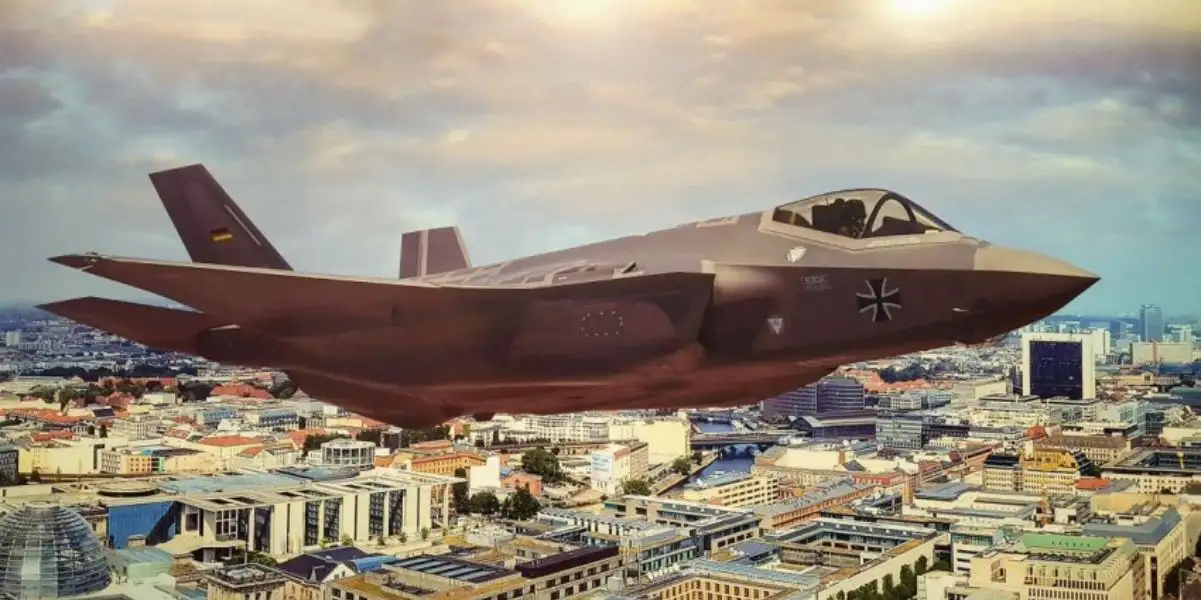
BERLIN — Germany is considering ordering more U.S.-made F-35 fighter jets, a move that could lift the country’s planned fleet to about 85 aircraft, people familiar with the talks said Thursday. The potential shift would deepen reliance on American combat aircraft technology as the Future Combat Air System, or FCAS, remains bogged down in Franco-German-Spanish disputes, putting renewed focus on whether a Germany F-35 buildup is becoming Berlin’s most practical bridge to the 2040s, Feb. 19, 2026.
Two sources told Reuters that negotiations could lead to a follow-on purchase of more than 35 additional F-35s, on top of the 35 aircraft Germany ordered in 2022 to begin replacing its Tornado fleet. Germany’s Defense Ministry did not immediately comment to Reuters, while a Pentagon spokesperson referred questions to Berlin and Lockheed Martin said it remains focused on building jets already on order.
Germany F-35 expansion: what Berlin is weighing
For German planners, the attraction of adding to the current buy is straightforward: it gives the Luftwaffe more capacity in the same fleet, faster, while Europe’s long-range sixth-generation projects remain years from a prototype, let alone operational service. According to the Bundeswehr, the first German F-35s are planned to arrive in the United States in 2026 for technician and pilot training, with initial aircraft expected to reach the main operating base at Büchel in late 2027. The timeline and base upgrades are outlined in a Luftwaffe background brief.
A larger Germany F-35 fleet would also widen Germany’s options for conventional strike, air defense and multinational operations — and it would simplify training, spare parts and software modernization compared with running multiple small fleets. Reuters reported the aircraft were being discussed at a cost of more than $80 million per plane, before counting weapons, spares, simulators, training and the base infrastructure required for a fifth-generation aircraft.
Germany F-35 and NATO’s nuclear-sharing mission
The decision is tied tightly to NATO’s nuclear-sharing arrangements. The F-35A is the only Western stealth fighter publicly confirmed as operationally certified to carry the modern B61-12 gravity bomb, according to a 2024 report from Breaking Defense citing the F-35 Joint Program Office. Germany does not have nuclear weapons of its own, but it maintains aircraft and crews intended to deliver U.S. bombs stored in Europe if NATO agrees to use them.
Why FCAS is under renewed pressure
Berlin’s latest deliberations come as FCAS — a roughly 100 billion-euro effort launched in 2017 — struggles to stay on schedule and aligned across partner requirements. FCAS is designed as a “system of systems” centered on a new manned fighter, plus a “combat cloud” network and drone-like “remote carriers,” as outlined in an analysis by the European Council on Foreign Relations.
Industrial rivalries have repeatedly slowed progress, particularly around who leads the core aircraft work and how sensitive technologies are shared. At the Munich Security Conference, an industry source told Breaking Defense that negotiations between Airbus and Dassault on the next phase of the next-generation fighter were effectively halted, even as political leaders floated the idea of salvaging other FCAS pillars.
German Chancellor Friedrich Merz has also pushed the question back into the political mainstream. “Will we still need a manned fighter jet in 20 years’ time?” Merz said in a podcast cited by Reuters, arguing that the pace of technological change makes massive long-term bets harder to justify.
How the Germany F-35 debate got here
The current Germany F-35 discussion is the latest swing in a four-year arc shaped by Russia’s war on Ukraine, NATO’s deterrence posture and Europe’s industrial politics.
March 2022: Germany announced it would buy up to 35 F-35A aircraft to replace part of its Tornado fleet, a decision framed at the time as strengthening deterrence after the war in Ukraine began, according to The Associated Press.
December 2022: Germany’s defense ministry said the Bundestag budget committee released funding of about 8.3 billion euros for 35 F-35A aircraft, clearing the way for the Foreign Military Sales process to move into implementation, in a government update.
March 2024: The F-35A’s reported B61-12 certification reinforced the aircraft’s role in NATO nuclear sharing and sharpened the strategic case for getting Germany’s F-35 transition completed before the Tornado exits service.
Now, with FCAS still mired in disputes and timelines, Germany F-35 numbers are again at the center of Berlin’s airpower planning — and, by extension, the balance between European strategic autonomy and reliance on U.S. high-end combat aircraft.
What happens next
German Defense Minister Boris Pistorius has said the fate of FCAS should become clearer within days, and any Germany F-35 expansion would require political approval as well as parliamentary budget scrutiny. For France, which has long pitched FCAS as a cornerstone of European defense sovereignty, a German tilt toward a much larger F-35 fleet would be a symbolic and industrial setback — even if Berlin and Paris keep cooperating on drones, networks and other parts of the broader air-combat system.