

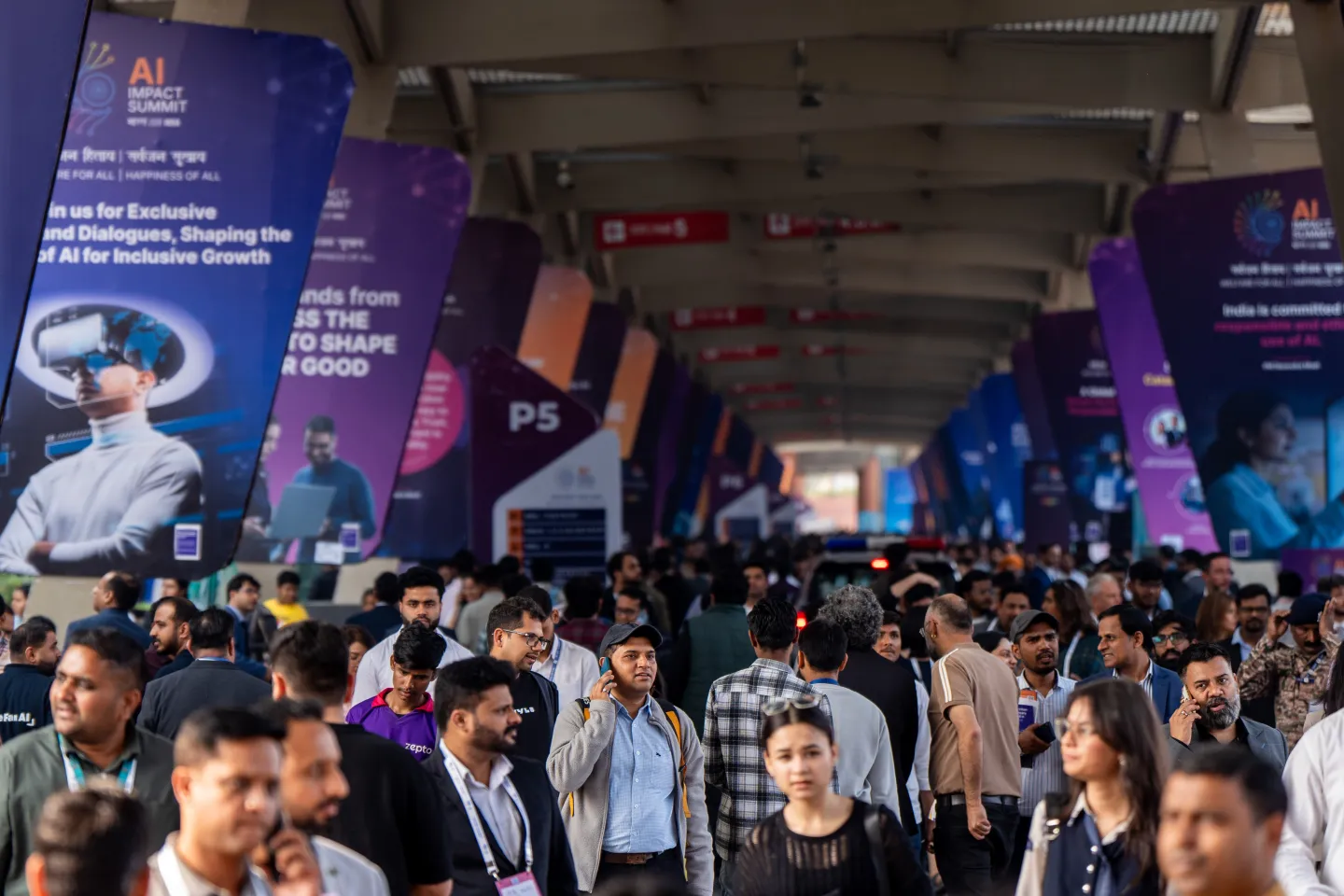
In her summit speech, Busch thanked India for becoming the first country from the Global South to host the forum and said the India-Sweden partnership should think about AI through four lenses: energy, talent, regulatory pragmatism and trust. Her formulation was not only diplomatic praise. It matched India’s own case that leadership in AI will not be settled only by who builds the biggest models first, but by who can deploy the technology at public scale without losing sight of values.
That is the wider strategic message New Delhi has been trying to send. Reuters reported before the summit that Indian officials were positioning the gathering as a platform for developing nations and as a showcase for application-led innovation, even while U.S. and Chinese companies still dominate the frontier-model conversation. In other words, India is not pretending the race at the top of the stack does not matter. It is arguing that the next durable advantage may come from diffusion: cheaper compute, local-language tools and real use in health care, education, agriculture and governance.
Busch arrived with political and commercial intent. Sweden said ahead of the visit that she would travel with a large Swedish business delegation and join leaders from more than 30 countries. That matters because Sweden is not treating India as a symbolic stop on the summit circuit. It is treating India as a serious long-term partner in AI, industry and trade, a framing Busch reinforced when she described trust and democratic cooperation as strategic assets rather than soft language.
India AI Impact Summit and the case for a third AI path
The strongest expression of India’s thesis came in a summit discussion on how to move from pilots to population impact. The official account of that session emphasized procurement reform, digital public infrastructure, data governance, interoperability and institutional capacity as the real conditions for scaling AI. That is a very different emphasis from the prestige politics of model size alone. It suggests India wants to be judged by whether AI can work reliably inside public systems and daily life, not just by whether an Indian company can outspend Silicon Valley or China on a single flagship model.
India also used the summit week to show that this push is not merely rhetorical. In the government’s official post-summit outcome note, New Delhi said delegations from more than 100 countries and 20 international organisations took part, that 92 countries and organisations backed the summit declaration, and that India would expand sovereign compute capacity beyond the 38,000-plus GPUs already provisioned under the IndiaAI Mission by adding another 20,000. Those numbers gave the “inclusive AI” pitch harder edges: public compute, shared access and multilateral buy-in.
That is why Busch’s endorsement landed cleanly. Her speech did not claim India had already overtaken the United States or China in frontier AI. Instead, it validated India’s argument that there is room for another center of gravity in global AI: one built around trusted rules, democratic coordination, lower-cost access and deployment at national scale. For countries that do not want the future of AI reduced to two superpower blocs and a handful of companies, that is a message with obvious appeal.
Why this India AI Impact Summit moment has been building for years
This direction did not appear overnight. It runs from the March 2024 cabinet approval of the IndiaAI Mission, which set out public compute, foundational models, startup financing and safe deployment, through the February 2025 India-France joint statement that welcomed India’s turn to host the next global AI summit, to the July 2025 government outline promising a 2026 summit focused on democratizing AI for real-world challenges. Read together, those milestones show continuity, not improvisation.
The real test comes next. Hosting a summit and attracting endorsements is one thing; turning that momentum into cheaper compute, stronger local models, better public services and credible guardrails is another. Still, Busch’s intervention gave India something valuable: outside validation that its AI strategy is being noticed not only as a national industrial project, but as a plausible template for countries looking for an AI future beyond the narrow geometry of the U.S.-China rivalry.


