

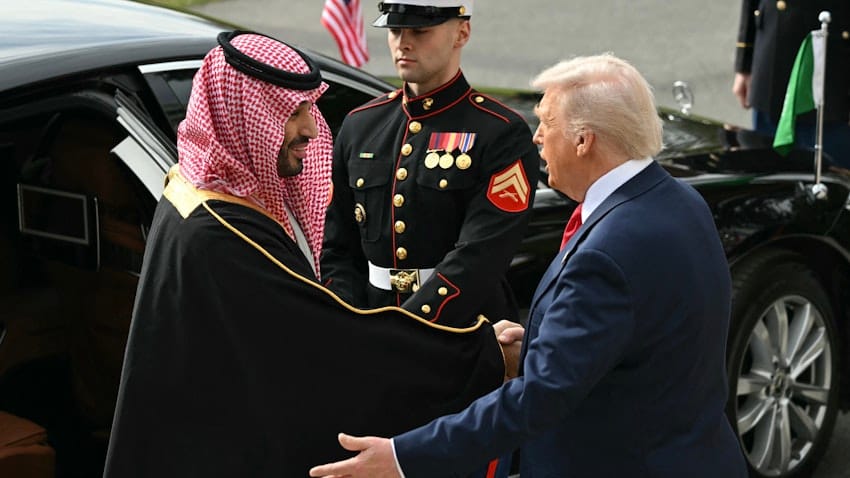
WASHINGTON — The Trump-MBS meeting at the White House to sign a Strategic Defence Agreement & make a grand announcement that Saudi investment is going to hit nearly $1 trillion in the U.S. from MBS’s Washington visit, Nov. 20, 2025
Supporters say the deal will dissuade Iran and protect American jobs, while critics assert that the Trump-MBS meeting further enmeshes the United States with an authoritarian ally and marginalises human rights.
A White House fact sheet summarising the Strategic Defence Agreement says the pact formally makes Saudi Arabia a major non-NATO ally, expands joint exercises and basing access, and removes obstacles to future arms sales, but falls short of a NATO-style mutual defence guarantee that Riyadh had previously sought.
For American weapons makers, the Trump-MBS meeting was a drop-everything moment: The crown prince meant tens of billions in new business. The agreement would also permit Washington to sell F-35 stealth fighters and nearly 300 Abrams tanks, as part of a broader package that could include advanced drones and other weapons technology, according to one trade publication, Breaking Defence.
The Saudi side saw the Trump-MBS meeting as a way of showcasing its previous commitment to invest $600 billion in the United States, with total planned investment reaching around $1 trillion ($653 billion) over the coming years in everything from nuclear energy to artificial intelligence, according to a detailed Reuters breakdown of the investment package.
The package also includes a longstanding agreement on civil nuclear cooperation in which American companies would help construct Saudi reactors, while the kingdom would agree not to enrich uranium within its borders. Senators of both parties cautioned that any nuclear agreement must prevent a regional arms race, a concern raised in recent Reuters coverage of congressional hearings.
Analysts had been discussing an analogous package under President Joe Biden before Trump and MBS met, which had included a security pledge and nuclear cooperation as elements of a potential Saudi-Israeli normalisation agreement. A 2024 Brookings paper, “Making sense of a proposed U.S.-Saudi deal,” explained that such an agreement could offer American guarantees in exchange for limitations on Saudi relations with China and assurances regarding its nuclear program.
Think tank analysis from the Biden years, including a 2023 CSIS assessment of efforts to bring Saudi Arabia into the Abraham Accords, revealed that Washington was already considering a defence pact, nuclear cooperation and Israeli concessions to the Palestinians — highlighting how Trump’s agreement is built on, rather than supplants, U.S. diplomacy that came before it.
It was also the warmth of the Trump-MBS meeting that reignited anger over Jamal Khashoggi, a dissident Saudi journalist who was murdered in 2018 in Istanbul. In a joint appearance this week, Trump once more rejected U.S. intelligence conclusions that the crown prince ordered the killing, saying the heir “had absolutely no knowledge” of it, and the AP account of his visit quoted him as saying: The prince knew nothing.”
Khashoggi’s killing at the Saudi consulate, which a heavily referenced chronology of the 2018 killing detailed in full, led the C.I.A. to conclude that bin Salman ordered the operation, and prompted calls in Congress to limit arms sales. And although some constraints ensued, subsequent administrations maintained firm lines of security cooperation with Riyadh.
The new defence pact also echoes Trump’s first-term trip to Riyadh, when he unveiled letters of intent for more than $110 billion in Saudi arms sales. At the time, news organisations like Al Jazeera covered the 2017 arms deals, which had been billed as a significant increase in U.S.-Saudi security cooperation but later faced questions about how many of those contracts actually came to fruition.
The promise of a nearly trillion-dollar investment today makes those sums paltry in comparison, though it may also be more challenging to deliver the full amount — Saudi Arabia has massively increased domestic spending in recent years, and its budget is heavily reliant on oil exports. Qatar University, the alma mater of many in its government, reviewed how Riyadh’s previous $600 billion pledge could take years to materialise, even under ideal market conditions.
Human rights advocates say the Trump-MBS meeting handsomely rewards an insurgency-minded monarchy whose repression has steadily worsened over the past year. Organisations that once pushed for Biden to treat Saudi Arabia as a “pariah” now caution that increasing arms sales and nuclear cooperation — absent conditions on political prisoners or dissent — undermine U.S. leverage and send a permissive signal to other authoritarian clients.
On Capitol Hill, lawmakers from both parties promised close scrutiny of the Strategic Defence Agreement and the associated arms and nuclear agreements. Analysts at the Atlantic Council and Defence Priorities emphasise that, however symbolic the Trump-MBS meeting, the pact does not amount to a treaty-level commitment to defend Saudi Arabia in any eventual war.
A lot will now depend on how fast Congress moves to scrutinise major weapons sales and whether a formal, albeit modest, nuclear cooperation agreement is sent for approval, not to mention how Riyadh manages regional flashpoints from Gaza to Iran. For Washington, the meeting between President Trump and MBS was a demonstration of both the enduring pull of Saudi money in this city and the still-unsettled debate over how closely the United States should align its security interests with that kingdom.


