

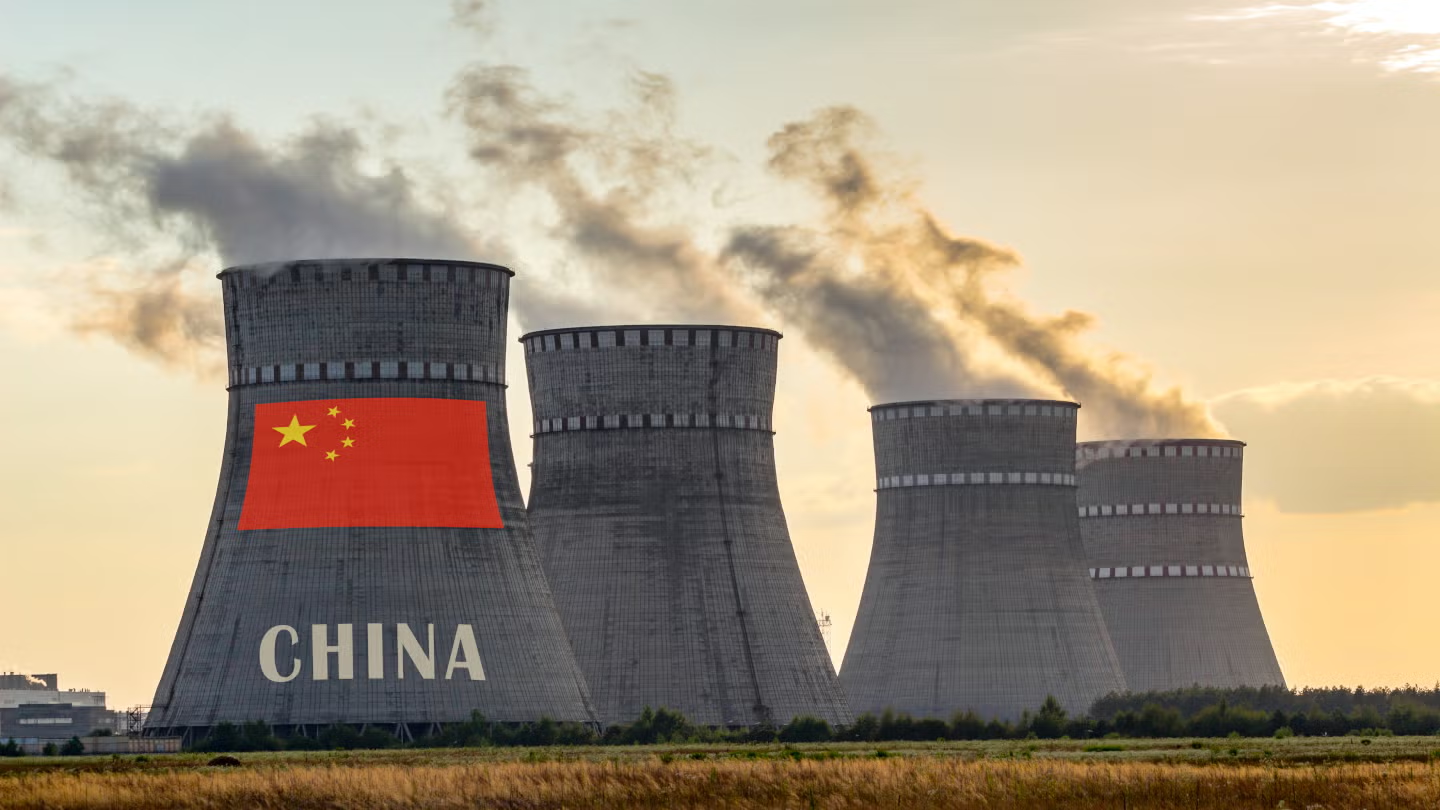
WASHINGTON — U.S. export approvals that let Westinghouse transfer its AP1000 reactor design to Chinese state partners starting in 2007 are still shaping China nuclear power, as Beijing builds new plants and advances next-generation reactors. The deal’s technology-transfer terms helped Chinese manufacturers localize key components and turn a one-time purchase into a repeatable domestic model, Dec. 21, 2025.
China nuclear power and the AP1000 pipeline
In a January 2007 World Nuclear News report, Westinghouse was described as the “technology basis” for four reactors, and the outlet said the technology-transfer terms were negotiated at the highest levels. It reported that then-U.S. Energy Secretary Sam Bodman attended talks and signed a memorandum supporting technology transfer — and that the Energy Department would put up $218 million toward a $436 million AP1000 detailed design effort.
A supplier contract showed how specific the transfer could get. In a 2007 Curtiss-Wright press release, the company said its agreement with China’s State Nuclear Power Technology Corp. included a 15-year license to manufacture AP1000 reactor coolant pumps for future plants in China, while pump hardware for the first projects would be produced in Pennsylvania.
Those kinds of licenses matter because “localization” is where a sale becomes an industry. Westinghouse executives publicly anticipated a rising share of Chinese sourcing as projects progressed, and later agreements expanded the handoff from heavy components into engineering support and plant systems — the know-how that determines how quickly a country can replicate a design.
By 2011, Power Engineering reported that Westinghouse signed consulting agreements to support CAP1400, a larger, passively safe design developed from the AP1000 and intended to carry Chinese intellectual property rights. The same article said Westinghouse’s earlier AP1000 contracts enabled China to develop its own fleet.
And in 2013, World Nuclear News reported that Westinghouse and a Chinese partner were working to provide instrumentation and control systems for future AP1000 projects — a sign that localization was moving beyond steel and concrete and into the digital “nervous system” of a nuclear plant.
A 2024 report by the Information Technology and Innovation Foundation argues that AP1000 technology transfer “significantly accelerated” China’s commercial nuclear industry and became a basis for Chinese AP1000-derived designs. In practice, that means China nuclear power gained a benchmark for safety-grade manufacturing, a template for faster builds and a platform for domestic upgrades.
Scale has amplified the learning curve. The International Atomic Energy Agency’s PRIS reactor database lists 58 power reactors operating in China and 28 under construction. The PRIS listings also show AP1000 units at Sanmen and Haiyang entering service in 2018, with additional units under construction at both sites — evidence of how China nuclear power turned a marquee import into repeat construction.
China nuclear power moves into molten-salt territory
China nuclear power is also pushing beyond the pressurized-water workhorse that dominates today’s fleets. The Chinese Academy of Sciences said in November that its Shanghai Institute of Applied Physics achieved the first-ever thorium-to-uranium nuclear fuel conversion in an operating thorium molten-salt reactor, calling it a milestone for using China’s thorium resources and setting a goal of a 100-megawatt demonstration project by 2035.
For U.S. policymakers, the takeaway is less about hindsight blame than about managing strategic spillover. A deal framed in the 2000s as a commercial and diplomatic win helped seed capabilities that now help define China nuclear power — and the competition increasingly hinges on standards, supply chains and influence as much as electricity.


