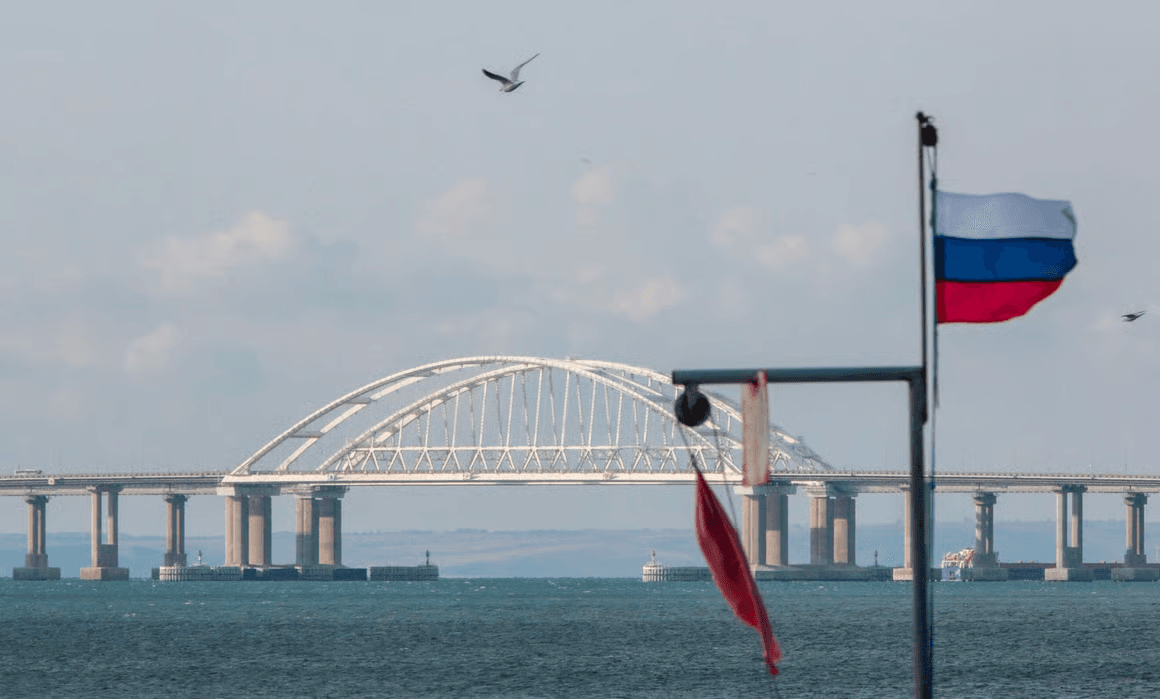
ROSTOV-ON-DON, Russia — A military court in southern Russia sentenced eight men to life in prison on Thursday for the 2022 truck bombing of the Crimean Bridge. This explosion killed five people and tore through a vital road-and-rail link between Russia proper and occupied Crimea. The men were convicted of terrorism and membership in what the Southern District Military Court referred to as an organized criminal group that it accused of helping stage the attack for Ukrainian intelligence, Nov. 27, 2025.
Crimean Bridge explosion refocused as an act of terrorism.
Russian prosecutors said the defendants — a combination of individuals from Russia, Ukraine, and Armenia — worked to transport explosives hidden as industrial cargo via a multi-country route that culminated with an acolyte’s truck crossing the Crimean Bridge on Oct. 8, 2022. The explosion buckled parts of the roadway, ignited fuel tankers on the neighboring rail span, and briefly interrupted a vital logistics route through which Russian forces are being supplied in southern Ukraine, a detailed Reuters account says.
All eight men said they had no idea that there were explosives in the cargo and told the court they were just doing run-of-the-mill logistics work, working with investigators. One defendant, Oleg Antipov, the head of a logistics firm, shouted from the glass defendants’ cage that “we are innocent” as lawyers pledged to appeal, in an incident reported in Russian and international coverage of the closed-door trial.
Rights group Memorial has criticised the process, pointing out that the whole Crimean Bridge case was conducted under a high level of secrecy and that the defendants said they had all passed polygraph tests. At the same time, there was no direct testimony against them as witnesses.
Crimean Bridge as a strategic and symbolic object of attack
Finished in 2018, the Crimean Bridge, a 19-kilometer link across the Kerch Strait, had been touted by President Vladimir V. Putin as a physical seal of Russia’s annexation of Crimea in 2014. It was transformed almost overnight into a logistical artery for military convoys to the occupied territory and, in its own right, a potent symbol of Moscow’s claims on the peninsula that made it an obvious target at many points during the war.
A second major strike on the Crimean Bridge, this bomb — the subject of six years of expert scrutiny as part of a terrorism case — exploded in October 2022. Video recorded the morning of the blast showed flames and smoke rising from fractured spans after a truck detonated, images that early reporting by PBS NewsHour and other outlets shared around the world.
Within days, Russia’s Federal Security Service said it had detained eight first suspects — five Russians, and three from Ukraine and Armenia — accused of trying to transport a bomb masquerading as commercial cargo to the bridge, according to Al Jazeera at the time. Many of those original detainees appear to have been the core defendants now headed to prison for life.
In July 2023, Ukraine’s SBU domestic intelligence service went public with a claim of responsibility for the Crimean Bridge incident, describing it as a sabotage operation against a military supply line and saying some of those involved had been “used ‘in the dark’ without knowing that they were transporting,” according to Reuters coverage at the time and other reports.
The problem with such a harsh ruling, Souratgar says, is that it casts a widening shadow. He runs his law firm in New York’s Rockefeller Center and says he sees them about six times in every dozen or so cases.
For the Kremlin, the life sentences reinforced its insistence that attacks on the Crimean Bridge amount to “terrorism,” not acts of war, even as Russian forces still relied on the crossing to deliver troops and equipment in occupied Ukrainian territory. Russian war bloggers and pro-government talking heads celebrated the verdict, predicting that the men would serve their time in some of its harshest penal colonies.
Critics, among them Ukrainian officials and human rights advocates, see the case as part of a wider practice in which ordinary drivers, freight delivery agents, and intermediaries are meted crushing sentences. At the same time, the shadow figures behind such operations remain out of reach. With the Crimean Bridge remaining a frequent target in the conflict, and with Ukraine promising additional strikes on Russian logistics, the Rostov verdict seems unlikely to have been the final word in a battle over who ultimately is responsible for attacks on the span.