
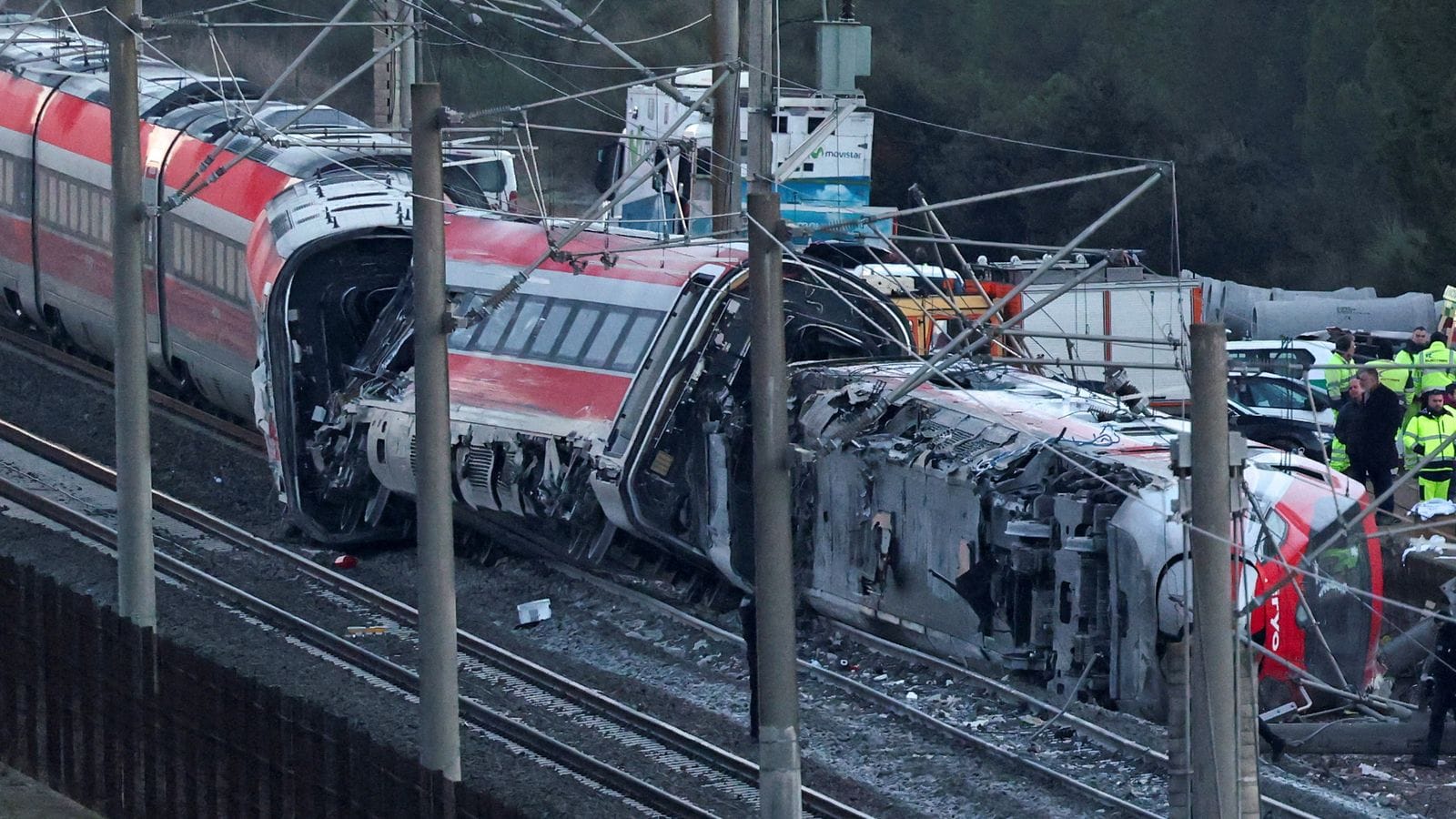
MADRID — Investigators probing the Spain train crash that happened Sunday night near Adamuz are focusing on a heavy metal component found in a nearby stream that may be the missing bogie from one of the derailed high-speed trains, officials and experts said Thursday. The undercarriage unit could help reconstruct how the first train left the rails and collided with an oncoming service, a disaster that has killed at least 43 people, Jan. 22, 2026.
Images published by Reuters show the part lying partly submerged beside a railway bridge about 15 meters below the tracks and roughly 300 meters from the derailment point, outside the cordoned investigation area. Spain’s Civil Guard located the piece Monday but left it in place because of its weight, Transport Minister Óscar Puente told national broadcaster TVE, calling it “one of hundreds of pieces of evidence” being collected; a source briefed on the probe said the bogie may have been hurled out “like a bullet.”
Spain train crash: why the missing bogie matters
In railway terms, a bogie is the wheel-and-suspension assembly under a carriage — the key point of contact between train and track. If investigators confirm the component came from the first train to derail, its damage patterns and final resting place could help map the train’s movements in the seconds before impact and test competing theories about whether a track defect, a mechanical failure or debris on the line triggered the Spain train crash.
Technicians have also examined the rail and joints at the derailment point, but investigators have not publicly identified a definitive cause. Renfe President Álvaro Fernández Heredia has said it is too early to draw conclusions, but that “human error is practically ruled out.” Puente has urged the public to avoid speculation, saying officials do not yet know whether the failure started in the rolling stock or the track, according to El País.
The Spain train crash occurred Sunday evening, Jan. 18, when the tail end of a Málaga-to-Madrid Iryo service derailed and crossed onto an adjacent line, where it was struck by an oncoming Renfe train traveling from Madrid toward Huelva, according to The Associated Press. Rescue crews have used cranes and heavy machinery to reach the worst-hit carriages in rural Córdoba province, and authorities have asked relatives of the missing to provide DNA samples for identification.
As Spain mourns, rail safety has become a broader political issue. The European Union Agency for Railways said it is monitoring developments with the European Commission and stands ready to support Spanish authorities as the Spain train crash inquiry continues.
Spain train crash renews scrutiny after past disasters
The scale of the Spain train crash has revived comparisons to earlier tragedies, including the 2013 derailment near Santiago de Compostela in northwestern Spain, which later killed 79 people, as reported at the time by the BBC. The outcome of that crash also underscored how long safety cases can take to wind through Spain’s courts and investigative bodies.
In July 2024, a Spanish court convicted the driver and a former ADIF safety official for their roles in the Santiago derailment and ordered compensation for victims, Reuters reported. For investigators in Adamuz, the immediate task is more basic: determine why a modern train derailed on a straight stretch and whether the suspected missing bogie holds the clue that finally explains the Spain train crash.