

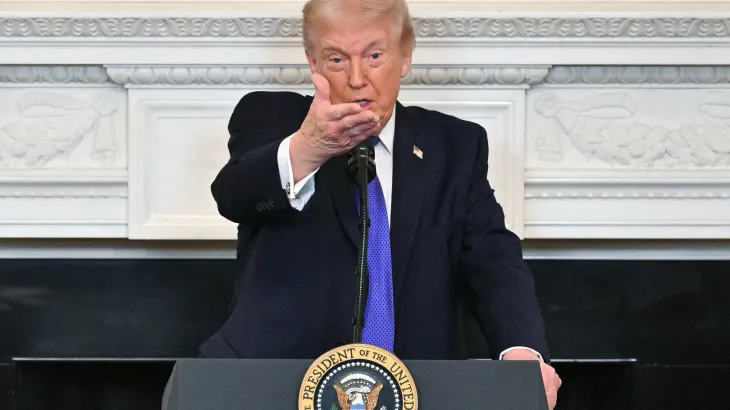
WASHINGTON — President Donald Trump ordered a major U.S. military operation against Iran that immediately triggered bipartisan blowback on Capitol Hill and reopened a fierce debate inside the Republican coalition over whether “America First” means escalation or restraint, Feb. 28, 2026.
Administration officials and key lawmakers have offered only partial details so far, but early reporting describes coordinated U.S.-Israeli strikes under the name “Operation Epic Fury,” alongside warnings from analysts and officials that Iran could respond through missiles, proxies, cyberattacks or other asymmetric means. Reuters reported Trump was briefed in advance that the mission carried “high risk, high reward,” including the possibility of significant U.S. casualties, according to people familiar with the deliberations.
Trump Iran Strike sets off an immediate war-powers clash
Within hours, lawmakers from both parties argued the president sidestepped Congress, setting up a fast-moving showdown over the War Powers Resolution and the constitutional authority to initiate hostilities. A bipartisan push is forming around efforts to force votes limiting further action absent congressional authorization, with members pressing for classified and public briefings on objectives, legal rationale and the expected duration of the campaign. PBS NewsHour outlined the plans to advance war-powers measures and the political pressure building for a recorded vote.
The administration’s legal posture is already under scrutiny, with experts split over how far a president can go without explicit authorization—particularly if operations broaden beyond a short, limited strike. Time examined the competing arguments about whether existing authorities apply and what Congress can realistically do to constrain a president once hostilities begin.
MAGA fractures over intervention, escalation and midterm risk
The dispute isn’t confined to Democrats versus Republicans. A vocal faction of Trump-aligned media figures, populist lawmakers and anti-intervention activists is warning that a prolonged conflict would collide with the movement’s backlash to “forever wars”—and could scramble turnout and fundraising math heading into the 2026 midterms. Axios reported that even some sympathetic MAGA voices are demanding swift results and a clear end state, reflecting anxiety that another Middle East entanglement could widen an existing intra-base split.
Meanwhile, some Republicans are rallying behind the strikes as a necessary step to deter Iran and reassert U.S. power, arguing that hesitation would invite more regional attacks and embolden Tehran. Democrats are divided too—between those who back the goal of preventing a nuclear-armed Iran and those who say the process matters as much as the outcome, especially if escalation becomes open-ended.
The political fog of war: what Congress says it still doesn’t know
Several senators and House members say they want straightforward answers before voting on any authorization or restrictions: What precise targets were struck? What intelligence standard was used? What is the administration’s definition of “success”? What conditions would trigger additional strikes, ground involvement, or expanded rules of engagement? CBS News collected initial statements from lawmakers calling for briefings and a clearer explanation of aims, even as some offered support for troops carrying out the mission.
Those questions are likely to intensify as lawmakers weigh the practical limits of war-powers tools. Even when Congress passes a resolution, presidents can veto it, and overriding a veto is historically difficult—leaving critics to argue that political pressure and public opinion may be Congress’ most immediate leverage.
Why this fight feels familiar: the long arc from Syria and Soleimani
The current standoff follows a well-worn pattern from Trump’s first term, when questions about unilateral force spiked after strikes in Syria and other flashpoints. In 2018, Lawfare analyzed the significance of the legal memo and oversight demands surrounding the 2017 Syria strikes, highlighting how war-powers disputes can turn on classified legal rationales that lawmakers often struggle to obtain quickly.
In 2020, the debate reignited after the U.S. killed Iranian Gen. Qassem Soleimani, with critics arguing the action tested constitutional boundaries and risked spiraling escalation. The Atlantic argued at the time that the strike raised fundamental questions about congressional consultation and the scope of presidential war authority.
More recently, the brewing split inside Trump’s coalition over a possible Iran confrontation was already visible well before this weekend’s operation. In 2025, The Washington Post reported that the prospect of strikes on Iran’s nuclear facilities was exposing tension between hawkish deterrence and the movement’s anti-intervention instincts—fault lines now widening under real-time battlefield decisions.
What happens next
In the near term, the administration faces two parallel tests: whether it can deter or blunt Iranian retaliation without widening the conflict, and whether it can persuade Congress—and a fractured base—that its strategy is limited, lawful and achievable. For Republicans staring down the 2026 midterms, the political danger is that a conflict meant to project strength could instead become a prolonged, messy fight that pits party factions against one another while dragging war powers back to the center of domestic politics.


